
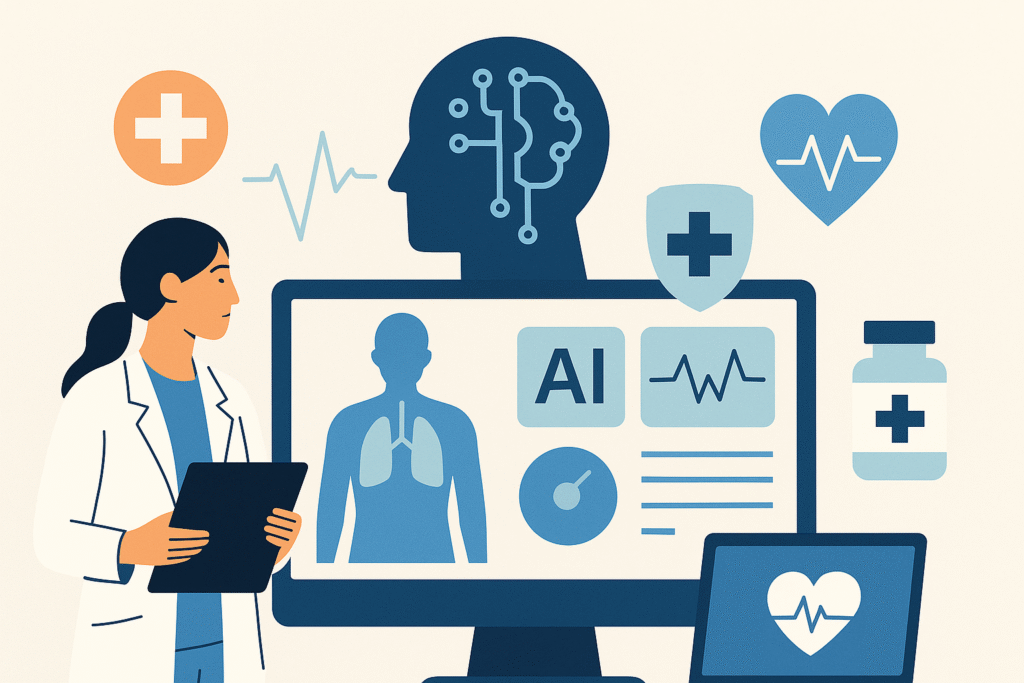
Artificial intelligence (AI) is no longer at the margins of healthcare it is moving to the very heart of how medicine is practiced in the United States. The questions are no longer if AI will transform healthcare, but how quickly and to what extent. From reducing diagnostic delays to predicting adverse events before they happen, AI is becoming a critical tool for ensuring better patient outcomes and building a stronger, more resilient healthcare system.
At SynaptiCare, we see AI as more than a tool for efficiency it is the foundation for a new era of proactive, patient-centered care.
AI in Diagnostics: Reducing Errors, Saving Lives
Every year, diagnostic errors contribute to delayed treatments and, tragically, preventable patient harm. According to recent U.S. studies, misdiagnoses account for nearly 10% of patient deaths. AI can help change that.
Machine learning models trained on thousands of radiology scans can flag subtle abnormalities that human eyes may miss. In pathology, AI can sift through gigabytes of cell images in minutes, highlighting the ones most likely to indicate disease. Importantly, these systems don’t replace doctors they augment their expertise. A radiologist supported by AI is still the one making the decision, but with faster, more reliable data at their fingertips.
This partnership between human judgment and machine precision can reduce diagnostic delays by up to 25% — a game-changer for cancer detection, cardiac events, and other time-sensitive conditions.
Clinical Workflows: Fighting Burnout, Restoring Focus
It’s no secret that clinicians in the U.S. are facing historic levels of burnout. Much of this stems from administrative overload: documentation, scheduling, billing, and patient communications.
AI is now tackling these challenges head-on. Intelligent triage bots can prioritize urgent cases before a physician even opens the chart. Scheduling algorithms reduce no-shows and optimize operating room usage. Natural language processing (NLP) systems automatically generate clinical notes from patient-doctor conversations.
The result? Doctors spend more time with patients, and less time behind a computer screen. That’s not just better for physicians’ mental health it directly improves the quality of care.
Predictive Patient Monitoring: From Reactive to Proactive Care
Perhaps the most exciting transformation lies in predictive patient monitoring.
The pandemic accelerated the adoption of remote patient monitoring (RPM) tools, where patients use wearables or home devices to track vitals such as heart rate, oxygen levels, or glucose. But the next leap is not just monitoring — it’s predicting.
By combining continuous data streams with AI, healthcare providers can identify subtle warning signals before they escalate. Imagine detecting cardiac stress three days before a potential heart attack, or predicting which post-surgery patients are most at risk for complications.
This shift from reactive to proactive medicine is the future of U.S. healthcare. It prevents costly hospitalizations, reduces system strain, and most importantly, saves lives.
Why This Matters for U.S. Healthcare Priorities
The U.S. spends more on healthcare than any other nation, yet millions remain underserved. AI has the potential to directly support federal and state priorities:
- Improving Access: AI-enabled telehealth and predictive care tools can extend reach to rural and underserved communities.
- Reducing Costs: By preventing avoidable hospitalizations, AI can ease the $4 trillion burden on the healthcare system.
- Strengthening Resilience: AI-driven systems help healthcare providers respond faster during national health crises like pandemics.
- Enhancing Quality: Data-driven insights support physicians in making better, faster decisions.
In other words, AI isn’t just a technological innovation it’s a strategic healthcare solution for the U.S. at large.
SynaptiCare’s Vision
At SynaptiCare, we believe that the future of medicine is a partnership between humans and machines. Our mission is simple yet ambitious: to give every clinician the tools they need to deliver faster, smarter, and more equitable care.
- Diagnostics: Our AI platforms are designed to be explainable, ensuring that clinicians understand and trust the insights.
- Monitoring: Our IoT + AI solutions turn raw patient data into real-time, predictive alerts.
- Workflows: We focus on automating the background noise so providers can focus on what matters most patients.
We are building not just software, but a national health infrastructure that is predictive, equitable, and resilient. From major hospital systems to rural clinics, SynaptiCare is committed to making sure no patient is left behind.
Looking Ahead: A Call to Action
The next decade will be decisive. The U.S. healthcare system faces challenges of cost, access, and equity that cannot be solved by human effort alone. But with AI, we have an unprecedented opportunity to reimagine healthcare delivery.
The future is not about replacing doctors with machines it’s about empowering them to do more, with greater precision and less burnout. It’s about shifting from sick care to true health care predictive, preventive, and personalized.
At SynaptiCare, we are proud to be part of this movement. Together with providers, policymakers, and innovators, we can build a healthcare system where every diagnosis is faster, every patient is monitored proactively, and every American has access to world-class care.
The future of healthcare is AI-powered. The future starts now.